E-Learning
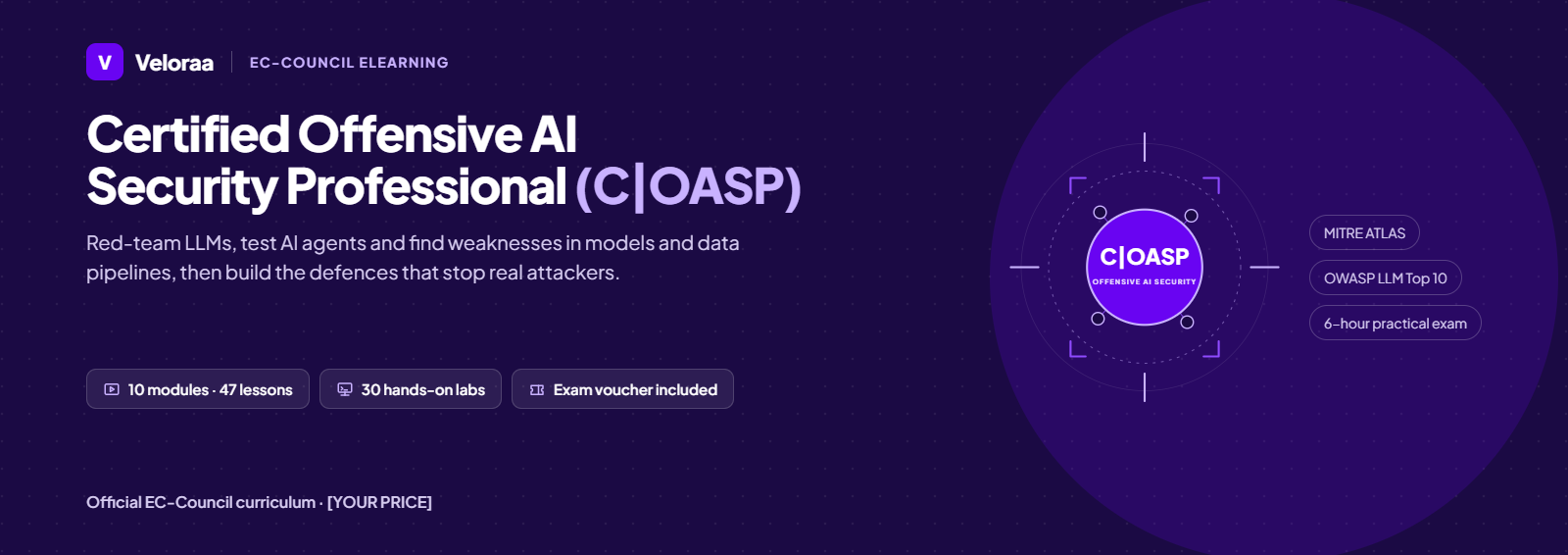
Certified Offensive AI Security Professional (C|OASP)
Learn to red-team LLMs, test AI agents and find weaknesses in models and data pipelines — then build the defences that stop real attackers. A hands-on EC-Council certification for security professionals. Self-paced, with 24/7 support.
Veloraa Training
COURSE INFORMATION
Your Learning, at a Glance
- Category
- E-Learning
- Duration
- Self-paced · ~9 hours of video
- Format
- Official EC-Council e-courseware
Course Overview
Learn to Break AI Systems — So You Can Secure Them
LLM applications and AI agents bring new attack surfaces that traditional penetration testing doesn’t cover: prompt injection, jailbreaks, data poisoning, model theft and agents that can be tricked into misusing their tools. The Certified Offensive AI Security Professional (C|OASP) from EC-Council teaches you to find these weaknesses before attackers do.
Across ten modules and 30 labs you work through the full offensive lifecycle — reconnaissance, scanning, exploitation, reporting, hardening and incident response — aligned to MITRE ATLAS and the OWASP Top 10 for LLMs. Veloraa pairs the official curriculum with real AI governance and security experience, so you can turn findings into fixes.
AI Is the New Attack Surface
Every chatbot, copilot and agent an organisation deploys is something attackers can probe.
Old Playbooks Fall Short
Prompt injection and agent hijacking need new testing methods, tools and skills.
AI Red-Teamers Are Scarce
Teams need people who can both attack AI systems and harden them.
Who Should Attend?
Security and AI professionals who test, defend or build AI systems
Not a beginner course: you’ll need a foundation in cybersecurity. AI or ML experience helps but isn’t required.
Learning Objectives
By the end of the course you will be able to:
- Map the attack surface - Map AI attack surfaces and adversary techniques to MITRE ATLAS and the OWASP LLM Top 10.
- Attack LLM applications - Test for prompt injection, jailbreaking and prompt chaining in controlled lab environments.
- Assess AI agents - Evaluate agents for memory corruption, tool misuse and checkpoint manipulation.
- Test models and data - Assess exposure to data poisoning, backdoors and model extraction.
- Secure the supply chain - Evaluate AI infrastructure, plugins and dependencies for weaknesses.
- Validate and report - Run structured AI security tests, validate findings and report them clearly.
- Harden AI systems - Build detection rules and hardening strategies that close the gaps you find.
- Respond to incidents - Detect, investigate and recover from AI security incidents.
Curriculum
Modules follow the order of a real AI red-team engagement, from scoping and reconnaissance through to reporting, hardening and incident response.
Offensive AI and AI System Hacking Methodology5 Lessons
- 1. AI and ML Fundamentals From an Offensive Perspective
- 2. AI Attack Surfaces and the Threat Landscape (MITRE ATLAS)
- 3. AI Hacking Methodologies and Attack Taxonomies
- 4. Scoping and Rules of Engagement for AI Assessments
- 5. Mapping to the OWASP Top 10 for LLM and ML (2025)
You Will Be Able To Think like an attacker: how AI systems are built, scoped and broken
AI Reconnaissance and Attack Surface Mapping5 Lessons
- 6. AI-focused OSINT
- 7. Profiling AI Assets and Data Pipelines
- 8. Enumerating AI Endpoints and APIs
- 9. Analysing Models and Vector Stores
- 10. Reducing Exposure and Monitoring With Threat Intelligence
You Will Be Able To Find and profile every AI asset an organisation exposes
AI Vulnerability Scanning and Fuzzing4 Lessons
- 11. Vulnerability Assessment Principles for AI
- 12. Scanning Models, Pipelines and Deployments
- 13. Fuzzing AI Interfaces
- 14. Building Scanning Into Security Workflows
You Will Be Able To Discover weaknesses in models, pipelines and deployments at scale
Prompt Injection and LLM Application Attacks6 Lessons
- 15. Prompt Injection and Jailbreaking
- 16. System Prompt Leakage
- 17. Sensitive Information Disclosure
- 18. Improper Output Handling
- 19. Advanced and Chained Prompt Attacks
- 20. Secure LLM Application Design
You Will Be Able To Test LLM apps the way real adversaries do, then design them securely
Adversarial Machine Learning and Model Privacy Attacks5 Lessons
- 21. Classes of Adversarial ML Attacks
- 22. Adversarial Inputs Across Data Types
- 23. Membership Inference and Model Extraction
- 24. Evaluating Model Robustness
- 25. Privacy-preserving Defences
You Will Be Able To Evaluate model robustness and protect training data
Data and Training Pipeline Attacks4 Lessons
- 26. Training Pipeline Architecture and Threats
- 27. Data Poisoning
- 28. Backdoor and Trojan Insertion
- 29. Safeguarding Data and Training
You Will Be Able To Understand poisoning and backdoors, and how to stop them
Agentic AI and Model-to-Model Attacks6 Lessons
- 30. Agentic AI Architecture
- 31. Excessive Agency and Tool Misuse
- 32. Cross-LLM and Model-To-Model Attacks
- 33. Denial-of-wallet and Resource Abuse
- 34. Multi-agent Orchestration Attacks
- 35. Defending AI Agents
You Will Be Able To Assess autonomous agents, their tools and their memory
AI Infrastructure and Supply Chain Attacks4 Lessons
- 36. Infrastructure and Integration Weaknesses
- 37. Abuse of Tools, Plugins and APIs
- 38. Model and Dependency Supply-Chain Risk
- 39. Hardening AI Infrastructure
You Will Be Able To Secure the platforms, plugins and dependencies AI relies on
AI Security Testing, Evaluation, and Hardening4 Lessons
- 40. AI Security Testing and Evaluation Methods
- 41. AI Red-Team Frameworks
- 42. Validating and Reporting Vulnerabilities
- 43. Hardening AI Systems
You Will Be Able To Turn findings into validated reports and stronger systems
AI Incident Response and Forensics4 Lessons
- 44. Detecting and Responding to AI Incidents
- 45. Collecting AI Logs and Telemetry
- 46. Root-cause Analysis
- 47. Capstone: Hands-On AI Red-Team Exercise
You Will Be Able To Detect, investigate and recover from AI security incidents
Downloadable Resources: Learn by doing: 30 lab exercises, 20+ hands-on offensive AI techniques and 15+ MITRE ATLAS techniques, using tools such as PyRIT, Garak, Burp Suite, OWASP ZAP, Atheris and the Adversarial Robustness Toolbox.
What’s Included
- 47 video lessons About 9 hours
- 1 year of access
- 30 hands-on labs 6 months of official lab access
- 20+ security tools PyRIT, Garak, Burp Suite, ART and more
- Official e-book 1 year of access
- Exam voucher Valid for 1 year
Where C|OASP Can Take You
AI Red Team Specialist
Adversarial AI Engineer
AI Security Architect
AI Threat Hunter
AI Incident Response Engineer
Secure AI / LLM Systems Engineer
Frequently Asked Questions
Is This a Beginner Course?
No. You need a foundation in cybersecurity — for example, experience in penetration testing, security operations or application security. AI or ML experience helps but isn’t required.
How Hands-On Is It?
Very. The course includes 30 lab exercises using 20+ AI security tools such as PyRIT, Garak, Burp Suite, OWASP ZAP and the Adversarial Robustness Toolbox.
How Long Do I Have to Finish?
About 9 hours of video across ten modules, plus lab time. You get 1 year of access to the e-book and video modules and 6 months of access to the official labs.
What Is the Exam Like?
A 6-hour, live-proctored exam with 70 questions: 65 multiple-choice and 5 practical, performance-based challenges. Your voucher is valid for one year.
Which Frameworks Does It Cover?
The course is mapped to the OWASP Top 10 for LLMs, MITRE ATLAS, NIST AI RMF and ISO/IEC 42001.
How Do I Keep the Certification?
Through EC-Council’s continuing education scheme: 120 ECE credits over a three-year cycle.
Can My Team Enrol Together?
Yes. Veloraa offers corporate and bespoke programmes. Use the enquiry form below for group pricing.
Exam & Certification
Your Path to Certification
The C|OASP exam is a 6-hour, live-proctored test with 65 multiple-choice questions and 5 practical challenges. Your voucher is valid for one year, so you can sit it when you feel ready.
- Complete the eLearning
10 modules · 47 lessons · 30 labs
- Pass the Exam
70 questions · 6 hours · live-proctored
- Earn Your C|OASP
Receive your EC-Council certificate
- Maintain It
120 ECE credits over 3 years
Exam Domains
- Offensive AI and AI System Hacking Methodology
- AI Reconnaissance and Attack Surface Mapping
- AI Vulnerability Scanning and Fuzzing
- Prompt Injection and LLM Application Attacks
- Adversarial Machine Learning and Model Privacy Attacks
- Data and Training Pipeline Attacks
- Agentic AI and Model-to-Model Attacks
- AI Infrastructure and Supply Chain Attacks
- AI Security Testing, Evaluation, and Hardening
- AI Incident Response and Forensics
Exam at a Glance
| Item | Details |
|---|---|
| Credential | Certified Offensive AI Security Professional (C|OASP) |
| Questions | 70 — 65 multiple choice + 5 practical challenges |
| Duration | 6 hours |
| Delivery | Live-proctored |
| Passing Score | [Confirm with EC-Council] |
| Voucher Validity | 1 year |
| Maintenance | 120 ECE credits / 3-year cycle |
C|OASP is awarded by EC-Council and is mapped to the OWASP LLM Top 10, MITRE ATLAS, NIST AI RMF and ISO/IEC 42001.
Happy Clients